
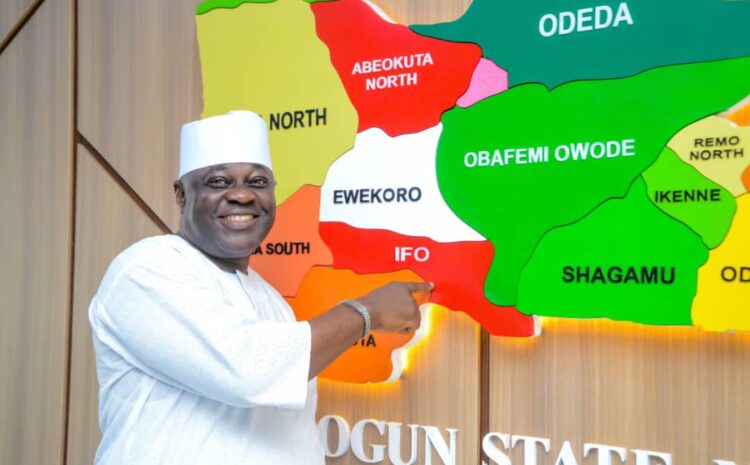
Politics often celebrates victories, but history remembers those whose impact outlives the offices they occupy. In Ifo Constituency II of Ogun State, the story of contemporary governance cannot be told without mentioning Hon. Fatiu Folawewo Salami, popularly known as FFS. His journey is one that illustrates how persistence, preparation, and hard work can transform temporary opportunities into lasting public service.
For many years, residents of Ifo Constituency II experienced periods of uneven development. While successive administrations recorded varying levels of progress, many communities continued to yearn for improved infrastructure, accessible healthcare, quality education, and effective political representation. It was against this backdrop that Fola Salami emerged as a new generation leader with a reputation for grassroots engagement and practical governance.
His first major executive responsibility came in January 2020, when he was sworn in as the Transition Committee Chairman of Ifo Local Government. The timing could hardly have been more challenging. Barely weeks into office, the COVID-19 pandemic disrupted governance across Nigeria, forcing governments at every level to redirect priorities toward emergency response. Economic activities slowed, public institutions were constrained, and development projects faced unprecedented obstacles.
Yet, within approximately eighteen months in office, Salami’s administration pursued projects that many residents still reference today. Despite limited resources and the uncertainties created by the pandemic, efforts were made to improve public infrastructure, rehabilitate schools, strengthen primary healthcare delivery, and expand access to potable water in underserved communities. Roads that had remained neglected for years reportedly received grading and rehabilitation, making transportation easier for residents and businesses.
One of the defining characteristics of his leadership during that period was an emphasis on equitable distribution of development. Communities that had long considered themselves overlooked began to witness government presence through health centres, school renovations, and basic public amenities. The philosophy was straightforward: every ward deserved to benefit from governance regardless of its political influence.
Observers also point to his leadership style as one rooted in accessibility. Rather than limiting governance to official offices, he maintained close engagement with community leaders, youth organisations, market associations, and traditional institutions. This approach helped him understand local concerns while building confidence between government and the people.
His tenure as Transition Committee Chairman also became historically significant. Following constitutional and political developments surrounding local government administration in Ogun State, he became the last Transition Committee Chairman to lead Ifo Local Government, making his administration an important chapter in the area’s political history.
Although his journey was not without political setbacks, they ultimately became stepping stones rather than stumbling blocks. Like many politicians, Fola Salami experienced electoral disappointment, but instead of retreating from public life, he continued to strengthen his relationship with the people. His persistence would later earn him the mandate to represent Ifo Constituency II in the Ogun State House of Assembly.
Since assuming legislative office, his approach has shifted from local administration to constituency representation, yet the underlying philosophy has remained unchanged: governance should produce visible and measurable benefits for ordinary people.
Across the constituency, his legislative years have been associated with interventions in infrastructure, education, agriculture, youth empowerment, and social welfare. Constituency projects have included facilitation of Police Station, Portable water schemes, drainage channelization and erosion control, construction of toilet for school pupils and management, facilitation of transformers to improve electricity supply in some communities, support for strategic road maintenance projects, and facitation of Adiyan ecological control project.
Residents and community development committees around the Adiyan Waterworks pipeline right of way have also acknowledged his interventions during periods of uncertainty over property demolitions and concerns arising from construction activities affecting their communities. Similar interventions were made around the Tipper Garage axis in Akute, where advocacy for road improvements preceded broader government action on the corridor.
His interest in education has equally been reflected through initiatives supporting young people, including supporting spelling bee and quiz competition, facilitation of JAMB registration opportunities for prospective tertiary institution candidates and educational assistance aimed at reducing barriers to higher learning. In agriculture, local farmers, particularly cassava growers, have benefited from the facilitation of farm inputs such as fertilisers, demonstrating an understanding that economic development begins with supporting productivity at the grassroots.
Access to clean water has remained another recurring priority. The facilitation of hand-pump boreholes in rural communities without reliable electricity addressed an immediate need while improving public health outcomes for residents who previously travelled long distances in search of potable water.
Employment facilitation has also featured prominently in his representation. Through collaborations with government agencies and relevant institutions, opportunities have reportedly been created for qualified constituents seeking public sector employment, reinforcing the idea that representation extends beyond lawmaking to improving livelihoods.
Perhaps one of the most remarkable aspects of his legislative stewardship is the widespread perception that every ward in Ifo Constituency II has experienced one form of democratic dividend or another. Whether through infrastructure, educational support, healthcare interventions, or community development projects, many residents believe governance has become more visible and accessible than in previous years.
Beyond projects, however, lies what may be his greatest achievement: reconnecting constituents with representative democracy. Today, many residents not only know who represents them in the Ogun State House of Assembly, but also recognise the importance of legislative representation and actively engage with their elected representative. This renewed relationship between the people and government reflects a broader understanding that effective representation is measured not merely by speeches on the floor of parliament, but by consistent presence within the constituency.
Like every public official, Fola Salami’s record remains open to public evaluation and debate. No administration is without criticism, and no leader is beyond scrutiny. Nevertheless, even many observers who differ with him politically acknowledge his consistency, accessibility, and determination to pursue development initiatives across the constituency.
His story is therefore not merely about occupying public office. It is about resilience in the face of uncertainty, perseverance after political setbacks, and an enduring commitment to grassroots development. It is the story of a leader who has repeatedly demonstrated that public service is not defined by titles alone but by the willingness to keep working long after the applause has faded.
In many respects, Fola Salami’s political journey offers an important lesson in leadership: persistence often achieves what talent alone cannot, and hard work remains the strongest foundation upon which enduring legacies are built. Whether measured by his tenure in local government or his service in the Ogun State House of Assembly, his career continues to reflect the values that have become synonymous with his name, consistency, resilience, and an unwavering commitment to the people of Ifo Constituency II.
By Ola of Ogun
